Call it Courage
About
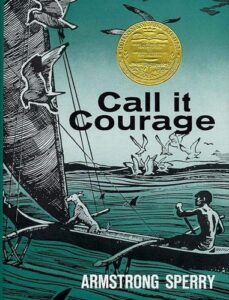
A legendary adventure story of how Mafatu, the son of the Great Chief of Hikueru, a Polynesian race who worships courage, conquers his fear of the sea and proves he isn't a coward.
Read one section at a time, then discuss the questions to review understanding. These questions are a starting place for conversation, not a complete test of the chapter.
Chapter 1
Comprehension questions
How did the author begin this story?
Page 1 — Giving the history and background of where this story came from
1
Do you think it was reasonable for Mafatu to be afraid of the sea? Why?
Page 3 — Listen to your child’s answer
3
How were Mafatu and Kivi similar?
Page 8 — They were both rejected by their peers and family
8
Why did Mafatu feel like he needed to leave the island?
Page 14 — His people had rejected him; he wanted to learn how to have courage; the boys his age were going out to hunt sharks and swordfish the next day and he was the only one not going
14
Chapter 2
Comprehension questions
List 2 similes or metaphors in this chapter.
Page 28 — “A monster livid and hungry p.24; empty as a shell p.25; as hard as the cut edge of a stone
28
Summarize this chapter.
Page 17 — Mafatu was out at sea; a storm came and broke up his canoe and stole away his paddle and food; he saw land and reached it but his canoe broke into splinters; he and his dog drug themselves onto the beach to a fresh water
17
Chapter 3
Comprehension questions
What examples of personification does the author use in this chapter?
Page 53 — The chuckle of the cascade p.36; coconuts and pandanus trooped in shining legions to the very edge of the sea p.38; it’s voice warm and soft and reassuring in his ear p.47; trees reached for him as he fled
53
How did Mafatu know he was not alone on the island?
Page 48 — He saw that fruit has been cut from the trees recently; he saw a path only humans could make; he saw terraces built by men;
48
How did Mafatu know which island he was on?
Page 50 — he saw bones that had recently been burned for sacrifice; he was on a eaters-of-men island
50
How did Mafatu show courage in this chapter?
Page 54 — He took the spear from the altar and touched a bone
54
Why does Mafatu think about the things that would please his father?
Page 59 — His father is ashamed of him; he’s thinking of ways he can show his father he has courage
59
Chapter 4
Comprehension questions
How did Mafatu prepare for this adventure before arriving on the island?
Page 64 — His previous life was making the same tools he needs on this island
64
What motivated Mafatu to dive into the water and kill the hammerhead shark?
Page 74 — His dog fell off the raft and the shark swam after him
74
Why was Mafatu so elated and proud of himself for killing a wild boar?
Page 78 — He did it with a spear which takes a lot of courage; he had courage to face the boar; his grandfather had killed one and was respected; he wants to be respected too
78
Why was Mafatu feeling more comfortable in the ocean?
Page 85 — He had lived near it and in it for weeks and grew confident in his ability
85
Why does Mafatu attribute his successes to Maui?
Page 93 — Maui is his God, and he believes Maui is helping him
93
Why was Mafatu so excited to return home?
Page 95 — He had found his courage and could now prove he wasn’t afraid any longer
95
Chapter 5
Comprehension questions
Summarize this chapter.
Page 97 — Mafatu was being chased by the eaters-of-men into the ocean, but after a long chase gave up; Mafatu grew discouraged when he sat on the ocean for days, but finally made it to his home island; his father was proud to call him his son
97
How did the author conclude this story?
Page 116 — He restated the first few lines that are at the very beginning of the book
116
Explain if you agree with this style of writing. Why, or why not?
Listen to your child’s answer
Downloads
All the book’s resources, or just the ones you need, ready to read or print.
Worksheets
Practice sheets with space to write your answers.
Download one reading section
A small printout with all the resources for the selected section.